

Buyers ask me for long-term partnership or regional exclusivity for a cable lug making machine before testing one unit. That exposes both sides. Our Wenzhou team prefers staged deals.
Negotiate long-term partnership or regional exclusivity for a cable lug making machine in stages: first build a stable purchasing relationship, then earn regional agency rights, and finally convert to exclusivity based on verified sales performance, Factory Acceptance Testing results, defined territory boundaries, and measurable minimum purchase obligations.
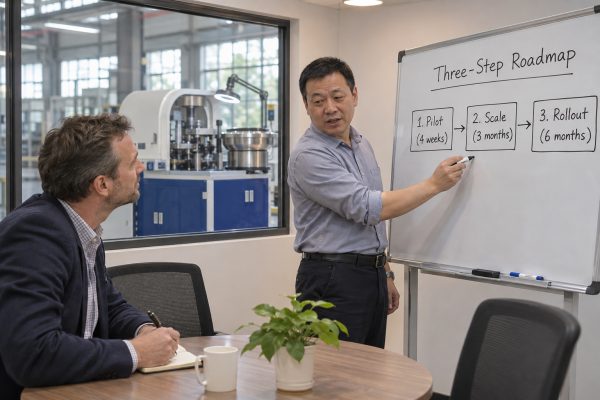
That three-step path is how I handle every exclusivity request today. It protects the buyer from an untested machine. It protects us from an untested partner. Below, I walk through the contract terms, the qualification process, the volume expectations, and the safeguards you need if things go wrong.
During a factory acceptance run for a German buyer, our PLC log showed a die change took longer than our brochure promised. That line sits in every contract we sign.
A long-term partnership agreement with a cable lug machine supplier should include defined product scope and standards, price protection, minimum purchase obligations tied to supplier performance, after-sales technical support SLAs, spare-parts availability, tooling ownership, Factory and Site Acceptance Testing criteria, confidentiality, and clear termination rights.

A long-term partnership agreement is not a purchase order with a longer date. It is a document that describes how two companies will behave for several years. I split the terms into two groups: the technical terms that keep the machine running, and the commercial terms that keep the deal profitable.
Start with product scope. The agreement must name the exact lug types the machine covers. That means copper or aluminum, tubular compression lugs, ring, fork, pin, and any custom terminals. Then name the standards. I never accept the phrase "international standard compliant" in a draft. We attach the exact standard and edition. For European buyers, that usually means DIN 46235 for compression lug dimensions 1 and marking, with DIN 48083 for the matching die coding. IEC 61238-1 covers the electrical and mechanical performance 2 of the connection. For our US customers, UL 486A-486B is the reference. The machine itself is not certified like the finished lug. So the contract must state that the equipment will reliably produce parts that meet those dimensional, mechanical, and electrical specifications.
Acceptance needs two gates. Factory Acceptance Testing 3 happens at our plant in Wenzhou using the buyer's own lug drawings and raw material. Site Acceptance Testing repeats the key checks after installation in the buyer's factory. Both protocols should define sampling, tolerances, scrap-rate limits, and die-change time. Our smart PLC control logs cycle data, so we also agree on data access. Many buyers now want full access to machine telemetry 4 so they can feed predictive maintenance into their own ERP. I support that, but it has to be written down.
| Clause | What it should state | Why it matters |
|---|---|---|
| Price protection | Fixed unit price or capped increase for the term, with currency treatment | Stops price rises after you develop the market |
| Minimum purchase obligation | Tiered targets that pause if the supplier delivers late | Keeps targets fair when delays are not your fault |
| After-sales technical support SLA | Remote acknowledgment time, on-site response time, maximum repair time | A stopped line kills the value of any territory |
| Spare parts and consumables | Price list, stock commitment, lead time, right to source high-wear dies locally | Protects supply chain reliability |
| Tooling ownership | Buyer owns custom dies and molds it paid for | Prevents lock-in and reuse for other clients |
| Buy-back or trade-in | Pre-agreed residual value toward next-generation equipment | Lowers lifecycle cost |
| Confidentiality | Non-disclosure agreement covering drawings, recipes, and customer lists | Enables honest technical exchange |
| Termination | Cause, convenience, notice, cure periods, inventory handling | Defines the exit before anyone invests heavily |
If the partner will also sell finished lugs under its own brand, add an OEM manufacturing agreement as a separate schedule. It covers trademark use, intellectual property protection 5 on our machine design, and who owns process recipes. A non-disclosure agreement should be signed before any drawings move in either direction.
Granting a wide territory feels generous, but it weakens the partner we pick. I weigh market evidence against ambition every time an exclusivity request lands on my desk.
To qualify for regional exclusivity rights on a cable lug making machine, present an evidence-based market case: documented customer demand, competitor pricing, applicable standards, trained service technicians, spare-parts inventory, a realistic territory, and a proven purchase history, then accept conditional exclusivity with performance-linked thresholds reviewed after 6–12 months.

Exclusivity is earned, not requested. That is the rule I follow, and it comes from the sequence my own business uses: build a stable purchasing relationship, then seek regional agency, then negotiate exclusive cooperation based on results. Here is how each step works in practice.
The first order is a nonexclusive evaluation. You buy one machine, or run a demonstration installation. We run Factory Acceptance Testing with your lug drawings. You run Site Acceptance Testing in your plant. During this period I watch three things: whether payments arrive on time, whether your technicians learn the machine, and whether you send real customer feedback. Those three signals tell me more than any forecast.
After a successful pilot, the partner can move to a regional agency role. This is still nonexclusive, but we start referring inquiries from your area to you. You start stocking consumables and dies. Distribution agreement terms at this stage cover commission on referred deals, marketing cooperation, and service responsibilities. This is also when we define territorial exclusivity versus channel exclusivity. Territorial exclusivity means no competing partner in your defined region. Channel exclusivity means we limit our own direct sales or online sales into your market. They are different promises, and you should ask for the one you can actually defend.
Once agency results are visible, we grant conditional exclusivity for 6–12 months. A performance review follows. If targets are met, the term extends and the territory may widen. If not, the agreement converts back to nonexclusive status instead of ending.
Suppliers hesitate for real reasons. We worry a partner will underinvest in marketing, demand more territory than it can serve, carry a competing machine line, or damage our brand through poor service. Your market case should answer each worry directly.
| Evidence you should bring | Evidence you should request from the supplier |
|---|---|
| Estimated annual lug demand and main customer groups | Installed-machine references in similar markets |
| Competitor brands and local prices | Production samples made to your drawings |
| Letters of intent, inquiries, or project pipelines | Output data under realistic product mix |
| Applicable standards (DIN, IEC, UL, regional) | Tooling life and replacement costs |
| Technical staffing and installation capability | Warranty claims history and service response records |
| Three-year sales forecast and marketing plan | Spare-parts availability and export documentation |
A small, well-documented territory with realistic targets is far easier for me to approve than a request for an entire continent.
A US distributor asked me on WhatsApp whether buying two machines a year would earn him an exclusive state territory. My honest reply: it depends on what else he commits.
Suppliers rarely publish fixed MOQs for exclusivity; they expect tiered minimum purchase obligations covering annual machine units, tooling and spare-parts spend, trained technicians, marketing activity, and customer projects, with first-year targets set low after a pilot order and raised in years two and three as performance is proven.

Machine units alone are a poor measure of a partner. A cable lug production line is capital equipment. A distributor may sell few units but create a strong installed base that buys dies, spare parts, and upgrades for years. So the minimum purchase obligation I write is a basket of commitments, not a single number.
The commitment basket changes with the partnership model. A contract manufacturer who makes lugs under its own brand may buy one line and then commit to production volume and consumable spend. An exclusive distributor commits to resale units and marketing. A regional service partner commits to technicians and parts inventory.
| Partnership model | Typical commitment types | Supplier's main concern |
|---|---|---|
| Exclusive distributor | Annual machine units, demo unit, trade-show participation, lead reporting | Underinvestment in marketing |
| Exclusive sales representative | Qualified leads per quarter, quotation follow-up, customer visits | Weak pipeline |
| Regional service partner | Trained technicians, spare-parts stock, response-time commitments | Brand damage from poor service |
| Contract manufacturer or OEM | Production volume, consumable spend, standards compliance | Quality of finished lugs |
| Joint venture or strategic production partnership | Capital, facility, staffing, shared marketing | Long-term alignment |
Performance-linked thresholds must run both ways. You should never lose regional exclusivity for a cable lug making machine because we shipped tooling late, delayed documentation, or missed a commissioning date. I write a clause that pauses the target clock whenever supplier delay is the cause. Targets should also account for certification timelines and import restrictions in your market, because these are outside your control.
Volume commitments work best when the payment structure is fair. I separate machine price from partnership rights. A lower unit price can be traded for an annual commitment or for permission to use your plant as a reference site. Payments should follow milestones: deposit, pre-shipment inspection, installation, successful production trial, final acceptance. The final payment is never due just because the crate arrived.
Two newer levers also help. A machine's energy-efficiency data can support "green" financing or trade credit terms in some markets. A pre-agreed trade-in credit toward next-generation automation lowers the real cost of a multi-year commitment. Both strengthen supply chain reliability for the partner without raising the supplier's risk.
The hardest lesson I learned exporting our machines is simple: a contract only protects you if its remedies are realistic to enforce across borders.
Protect your business by writing a territorial exclusivity clause with anti-circumvention rules, liquidated damages, lead referral duties, tooling and software ownership, documented spare-parts access, escrow or staged payments, a neutral arbitration venue, and a transition period with compensation if the supplier breaches or exits early.

Buyers tell me their biggest fears in plain words. The supplier appoints another distributor. The supplier sells direct to a big account in my region. The supplier raises prices after I build the market. The supplier discontinues the model and strands my tooling. Each fear has a matching clause. The table below shows how I map them.
| Breach or risk | Protective clause | Practical remedy |
|---|---|---|
| Competing distributor appointed in territory | Territorial exclusivity clause with named countries or states | Liquidated damages clause plus commission on the diverted sale |
| Direct sales or online sales into territory | Channel restriction and anti-circumvention rule covering affiliates and trading companies | Referral of inquiries and commission protection |
| Protected account approached by supplier | Customer-registration system with objective criteria and approval deadline | Compensation for accounts developed by the partner |
| Price increase after market development | Price protection for the term | Right to terminate without penalty or convert to nonexclusive |
| Model discontinued, tooling stranded | Tooling ownership, obsolete-part replacement, local consumable fabrication rights | Buyer may produce high-wear dies locally to OEM specs |
| Poor service response | After-sales technical support SLA with service credits | Credits against spare-parts purchases |
A territorial exclusivity clause fails if it only names direct sales. We must also cover sales through affiliates, online platforms, or distributors in neighboring regions. I agree to report leads and quotations that originate in your territory. Multinational and government tender accounts should be handled by a written carve-out rule, not left to argument later.
The strongest protection is not legal. It is operational. If you hold your custom dies, have full manuals, wiring diagrams, and parts lists, and have the right to fabricate crimping dies locally using our specifications, a breach hurts far less. Intellectual property protection cuts both ways here: we protect our machine design, and you protect your right to keep producing after termination. Software and firmware access after termination should be stated plainly.
Distinguish termination for cause from termination for convenience. Set notice and cure periods. Decide what happens to unsold inventory, open orders, pending commissions, and customer warranties. If you invested in a facility, certification, and market development, early termination by the supplier should trigger a transition period and compensation. Choose a neutral arbitration seat that both companies can realistically use.
Before you sign, run this checklist: territory, product range, standards, targets, machine acceptance, tooling ownership, warranty, service response, spare parts, price protection, customer protection, termination rights, and dispute resolution. Have a local lawyer and your own engineer review it together.
Rushing into exclusivity creates risk for both sides. Build purchasing trust first, earn regional agency, then let verified performance unlock exclusivity through a written, measurable agreement.
1. Official site of the German Institute for Standardization, which defines dimensions for compression lugs. ↩︎
2. International Electrotechnical Commission’s portal for standards regarding electrical and mechanical performance of connectors. ↩︎
3. Global organization providing technical resources and standards for Factory Acceptance Testing and equipment qualification. ↩︎
4. Technical professional organization providing research and standards for machine telemetry and industrial data systems. ↩︎
5. United Nations agency providing international frameworks and resources for intellectual property protection and policy. ↩︎
