

Supplier qualification fraud nearly cost one of our long-term buyers a six-figure order. On our workshop floor in Wenzhou, we hear these stories from disappointed importers every single month.
Spot supplier qualification fraud by authenticating business licenses, verifying ISO 9001 and CE certificate numbers with issuing bodies, demanding live unedited cutting demos on your own pipe material, checking export history records, and confirming real factory ownership through on-site or third-party audits before paying anything.
The scam is rarely a machine that does not exist. It is a qualification story that does not hold up. Let me show you how to test that story, step by step.
Last year, a German buyer sent me a competitor’s brochure and asked one sharp question: does this paperwork actually prove anything? Our engineers spent an afternoon showing him what real documents look like.
Verify the business license, factory ownership or lease proof, ISO 9001 certificate with a checkable number, CE Declaration of Conformity for the exact machine model, export history records, and model-specific technical documentation. Cross-check the registered legal entity name against every document to catch trading companies posing as manufacturers.

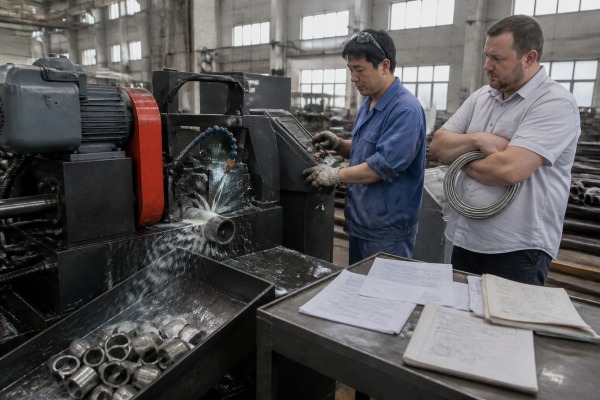
The most common trick I see in our industry is the manufacturer vs trading company disguise. A trading company registers a name that sounds like a factory, borrows photos from a real workshop 1, and quotes you as if it controls production. The paper trail exposes this fast, but only if you read the papers carefully.
Business license authentication is your starting point. In China, every company has a unified social credit code. Ask for the license, then check that the registered name matches the name on the proforma invoice, the CE certificate, and the export records. When one of our American distributors audits us, he checks exactly this chain. A mismatch is the classic fingerprint of a middleman.
Also cross-reference the business registration date 2 with the domain age of the supplier’s website. A “15-year factory” whose website and company were both created eighteen months ago deserves hard questions.
| Document | What to Verify | Red Flag |
|---|---|---|
| Business license | Legal name, registration date, business scope includes manufacturing | Scope says “trading” only |
| ISO 9001 certificate | Certificate number on the certifier’s official database | No number, expired, or unverifiable body |
| CE Declaration of Conformity | Covers the exact pipe cutting machine model | Generic certificate for “machinery” |
| Factory proof | Address matches license; satellite imagery shows a real plant | Residential or shared office address |
| Export history records | Customs data or bills of lading in the same company name | Records under a different entity |
| Machine documentation | Model-specific manuals, drawings, PLC software license certificates | Only glossy company brochures |
Demand original software license certificates for the PLC or CNC control system 3 too. A machine running cracked firmware is unstable, and it tells you the supplier cuts corners everywhere else.
Here is a trade-off we weigh honestly at our Wenzhou facility: real certification costs money and time, so some competitors skip it and buy “certificate packaging” instead. Buyers pay the price later.
Detect fake certifications by checking the unique certificate number directly on the issuing body’s official database, confirming the certificate scope covers pipe cutting machinery, and validating the auditor’s accreditation. Treat platform badges like audited supplier tags as screening signals, never as final proof.

The “certification packaging” scheme works in predictable ways. I have seen CE marks issued by bodies that do not exist. I have seen genuine ISO certificates 4 borrowed from a partner factory. I have seen “audited supplier” badges waved around as if a platform check equals a machinery validation. It does not. A platform audit confirms a company exists and has premises. It does not confirm that a fully automatic pipe cutting machine meets your tolerance on your steel.
| Signal | What It Actually Proves | What It Does Not Prove |
|---|---|---|
| ISO 9001 certificate | A quality management system was audited | Machine precision or model performance |
| CE mark | Declared conformity for a defined product | Independent testing of your configuration |
| Platform “audited supplier” badge | Premises and registration were checked | Manufacturing depth or engineering capability |
| Trade assurance protection | A dispute channel exists for the order | Qualification, quality, or after-sales capacity |
When buyers verify our own certificates this way, we welcome it. Honest factories lose nothing from scrutiny. Fraudulent ones lose everything, which is exactly why they deflect.
A procurement manager from Ohio once forwarded me a rival’s quote claiming ±0.15 feeding accuracy on any material, any wall thickness. Our technical lead laughed. Precision without context is a sales number, not an engineering number.
Red flags include accuracy claims stated without material, thickness, or standard context, vague machine ranges with no minimum length or ovality tolerance, refusal to cut your actual pipe, single hero-part demos instead of 50 to 100 consecutive parts, and generic client case studies with no verifiable details.

Capability exaggeration is subtler than outright fraud, which makes it more dangerous. The machine is real. The workshop is real. But the qualification story is inflated at every edge. In my years quoting metal processing machines to buyers in the US, Germany, and Japan, I have learned that the gap between brochure and reality lives in the details nobody prints.
| Exaggerated Claim | The Reality Check You Should Demand |
|---|---|
| ±0.15 feeding accuracy | Test conditions: which material, wall thickness, and measurement standard? Repeat over 50–100 consecutive parts |
| Fully automatic operation | Demo of loading, cutting, unloading, and real cycle time, not just automatic clamping |
| Wide OD range | Live cuts at your smallest and largest diameters, plus thickest wall |
| Handles all materials | Proof on coated pipe and mixed alloys, not only mild steel |
| High-capacity factory | Production capacity assessment on-site: machine count, staff, current work in progress |
Before you compare supplier claims at all, audit at least three months of your own cut lists. Capture your smallest and largest outer diameters, your wall thickness extremes, and every material grade. Then force the supplier to prove performance at those exact boundaries. Ask how the clamping system compensates for out-of-round pipe, and what the minimum pipe length is. Suppliers who exaggerate go quiet when the questions get this specific.
Also request high-resolution nameplate photos of critical sub-components. Cross-verify the serial numbers with original manufacturers like Siemens, Schneider, or Mitsubishi. Counterfeit or unbranded components hiding behind famous names are a capability lie in physical form. The same logic applies whether the machine uses abrasive cutting or CNC laser cutting technology: the components tell the truth even when the brochure does not.
One lesson our small Wenzhou team learned early: buyers do not trust claims, they trust evidence they can independently check. So we stopped saying “we export worldwide” and started showing shipment records to markets like the US, Germany, Japan, and Mexico.
Confirm export experience by requesting customs records or bills of lading in the supplier’s legal name, contacting two or three references in your own industry, verifying case-study details like machine serial numbers, and requiring a live-streamed demo with a buyer-specified marking cut into the sample.

The “fake customer case” scheme is now standard practice among fraudulent suppliers. They post stock photos of installations, name-drop industries, and list countries they have never shipped to. I have even seen our own product videos re-uploaded under a stranger’s brand. So treat every case study as a claim to be tested, not a fact to be accepted.
Not every order justifies a full audit, and I tell buyers this honestly. Match your effort to your risk:
Qualification fraud often ends with payment fraud. Implement a strict call-back protocol to a verified landline before honoring any sudden request to change banking details. And before shipment, use a third-party pre-shipment inspection, plus an audit of any remote maintenance module for unauthorized backdoor hardware. Then write everything into the contract: acceptance criteria, inspection rights, rejection terms, and a dimensional report across 50 to 100 consecutive parts. Verbal promises evaporate. Contract clauses do not.
Supplier qualification fraud thrives on unverified claims. Check the documents, test the certificates, demand repeated cuts on your own pipe, and put every promise into the contract. Trust evidence, never stories.
