

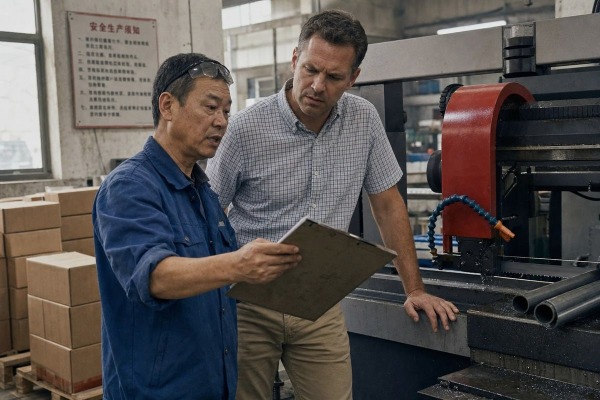
Verifying a pipe cutting machine 1 supplier’s U.S. customer track record is hard. On our production line in Wenzhou, I have watched buyers get burned by claims nobody checked.
To verify a pipe cutting machine supplier’s U.S. customer track record, request at least three named U.S. references, cross-check shipments against import customs data, confirm UL certification compliance, review installation documents, and validate that referenced customers are real, bought similar equipment, still cooperate, and run stable machines.
Below, I break this process into four practical questions. Each one gives you a concrete step you can act on before signing a purchase order.
Last year, a procurement manager from Ohio grilled our team for two hours about past U.S. installs. His questions were sharp. I now recommend every buyer copy his approach.
Ask the supplier which U.S. companies bought their machines, what exact models were delivered, when installation happened, whether the customer reordered, and how the equipment performs today. Then ask for proof: a customer reference list, Bill of Lading records, and commissioning documents.

Good questions separate marketing claims from verifiable proof. From my side of the table, I can tell you which questions make a weak supplier squirm. They are the specific ones. Anyone can say "we sell to the U.S." Very few can name the customer, the machine model, and the delivery date in one breath.
The four checks I always tell buyers to run come from our own experience: confirm the customer really exists, confirm they bought similar equipment, confirm the cooperation is ongoing, and confirm the machine runs stably. A one-time sale five years ago to an unrelated industry tells you almost nothing.
| Question | What a Strong Answer Looks Like | What a Weak Answer Looks Like |
|---|---|---|
| Who are your U.S. customers? | Named companies, cities, industries | "Many big brands" with no names |
| What model did they buy? | Exact model matching your quote | Vague "similar machines" |
| Is the cooperation ongoing? | Repeat orders, spare parts invoices | Single old order, no follow-up |
| How stable is the machine? | Uptime records, service tickets | "No complaints" with zero documents |
| Who handles after-sales? | Named technicians, response times | "Email us anytime" |
Also ask about consumables. Pipe cutting depends on blades, clamps, and coolant systems. A supplier with real U.S. clients will know which blade grades American shops prefer and how fast replacements ship. If they cannot discuss spare parts availability in detail, their U.S. experience is probably thin. Finally, ask whether their control software supports Imperial measurements natively. Rounding errors from metric conversion cause real precision loss in CNC tube fabrication, and experienced exporters solve this before shipment.
A buyer once told me he called all three references a competitor gave him. Two phone numbers were dead. That single check saved him a six-figure mistake.
Verify references by calling them independently, matching their claims against Bill of Lading records on platforms like Panjiva or ImportGenius, checking the reference company in state business registries, and finding additional unfiltered buyers through LinkedIn groups, industry forums, and trade shows like FABTECH.

References supplied by a seller can be curated. Some buyers argue that references are enough on their own. I disagree, and vendor due diligence 2 guidance backs me up: seller-provided contacts are selected precisely because they will say good things. You need independent confirmation, and you need it before money moves.
In our own export files, every U.S. shipment leaves a paper trail: booking confirmations, Bill of Lading records 3, commissioning sign-offs. Any legitimate supplier can produce the same. When I share these documents with buyers like William, our procurement contacts in the States, the conversation moves faster because trust is grounded in evidence, not promises. If a supplier resists sharing shipment proof for "confidentiality," ask for redacted copies. Refusing even that is a red flag.
Preparing a machine for the American market taught our engineers a hard lesson: electrical standards are non-negotiable. A control cabinet that passes in Europe can still fail a U.S. plant inspection.
Look for UL certification compliance or CSA marks on electrical systems, testing by an OSHA-recognized Nationally Recognized Testing Laboratory, CE plus U.S.-specific documentation, and U.S. product liability insurance. These prove the supplier engineered machines for American safety codes, not just generic export.

Certifications do not prove a customer track record by themselves. But they prove something adjacent and equally important: the supplier invested real money and engineering time to serve U.S. manufacturers legally and safely. A factory that never sold into America rarely bothers with NRTL testing, because it is expensive and slow.
| Certification / Proof | What It Covers | Why It Signals U.S. Experience |
|---|---|---|
| UL or CSA mark | Electrical safety of panels and wiring | Required by many U.S. plants and inspectors |
| NRTL field evaluation | On-site electrical approval | Shows machines passed real U.S. facility checks |
| OSHA-relevant guarding docs | Operator safety, blade guards, e-stops | Indicates familiarity with U.S. workplace rules |
| U.S. product liability insurance | Legal accountability in U.S. courts | Supplier accepts domestic legal jurisdiction |
| ISO 9001 quality system | Manufacturing process control | Baseline, but not U.S.-specific on its own |
Here is the objection I raise with my own customers: a certificate can be purchased once and never maintained. So pair the certificate check with two follow-ups. First, ask for the certificate number and verify it in the issuing body's public database. Second, ask which U.S. installation first required that certification. A supplier with real history will tell you a story: the customer, the state, the inspector's requirement. That narrative, matched against documents, is far harder to fake than a PDF. In industrial machinery procurement, the combination of verified marks plus verified installs is the standard I hold our own factory to.
Weighing a trade-off here is honest work. Case studies take suppliers days to prepare, and some buyers feel awkward asking. I still tell every serious buyer: ask anyway.
Yes. Request at least two detailed case studies of U.S.-based projects before trusting a supplier. Each should name the machine model, the material grades processed, measurable outcomes like uptime or tolerance held, installation photos, and evidence of ongoing after-sales technical support.

A real case study is not a brochure. It is a documented project with traceable details. When our team writes one for a cable lug production line or a cutting machine we shipped abroad, we include the commissioning checklist, the acceptance tolerances the customer signed off on, and the follow-up service tickets. Generic testimonials with customer logos but no documents behind them prove nothing.
Some buyers argue that a U.S. office proves a track record and makes case studies unnecessary. It does not. A domestic address may only be a sales office with no technicians and no parts. What matters is whether the supplier can support machines after the sale, which is exactly what a good case study reveals.
| Element | Why It Matters |
|---|---|
| Exact machine model and configuration | Ties the story to the machine you are buying |
| U.S. material grades processed | Shows experience with domestic steel, copper, and alloy specs |
| Measured outcomes | Uptime, cycle time, cut tolerance — numbers, not adjectives |
| Installation and commissioning records | Proves the machine actually ran on U.S. soil |
| Service history | Spare parts invoices and repair response times |
| Named or verifiable end user | Allows independent confirmation |
Use the case study to probe service footprint. Does the supplier work with North American service centers or U.S.-based partner technicians? Are critical consumables like specialized blades and sensors stocked in U.S. warehouses, or does every part ship from overseas? A low purchase price means little if a blown sensor idles your line for three weeks. Total cost of ownership, driven by uptime and parts access, is where cheap suppliers get expensive. Also check whether the supplier has exhibited consistently at U.S. trade shows such as FABTECH. Repeated attendance signals long-term financial commitment to the American market, not a one-off sales push.
Unverified claims cost real money in downtime and returns. Check that customers exist, bought similar machines, still cooperate, and run stable equipment — then compare prices with confidence.
1. Technical overview of pipe cutting methods and industrial machinery. ↩︎
2. Official U.S. government resource on performing due diligence for international business partners. ↩︎
3. Official U.S. Customs site explaining manifest data and confidentiality for shipment verification. ↩︎
