

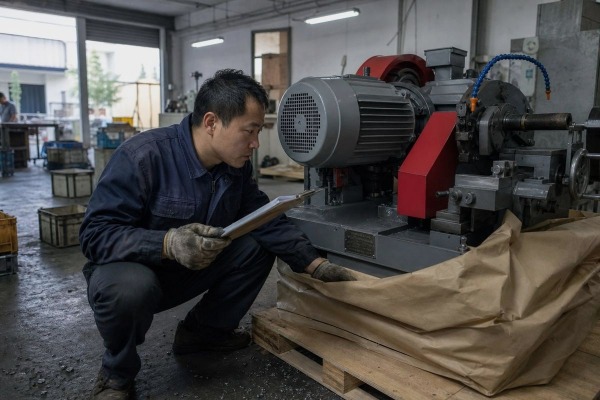
Before we ship any pipe cutting machine to a US buyer, our team runs a full voltage audit NEMA plug configuration 1. One skipped check can strand a machine that cannot even power on.
To check if a pipe cutting machine fits US voltage standards, verify the nameplate input voltage matches 120V, 208V, 240V, or 480V, confirm 60Hz frequency compatibility, identify single-phase or three-phase requirements, check amperage rating, and look for UL, CSA, or ETL certification marks.
That sounds like a lot. It is not. Below, I break each check into simple steps you can run before you sign a purchase order.
A few years back, a buyer in Ohio sent us a photo of his panel board before ordering National Electrical Code requirements 2. That single photo saved him weeks. Our factory in Wenzhou now asks every US customer for the same thing first.
Before importing, verify the machine's rated input voltage against your available US supply, confirm the motor and drive are rated for 60Hz or 50/60Hz operation, check the phase type, and record the full load amperage so your breaker and wiring can handle peak current.

My own rule of thumb, learned through exporting metal processing machines to the United States for years, is simple: first confirm the power supply conditions at the US customer's factory, then check the main power input specification on the machine, then verify the motor supports 60Hz. Do those three things in that order, and most compatibility problems disappear before the machine even leaves China.
The motor nameplate data is your single source of truth. Do not trust the listing page. Many sellers write "110V" or "220V" loosely, but in North America these correspond to nominal 120V and 240V systems. The nameplate should list input voltage, input current, phase, frequency, rated power, duty cycle, and often a country-specific model code.
Here is what US facilities actually run on:
| US Supply Type | Voltage | Phase | Typical Use |
|---|---|---|---|
| Residential outlet | 120V, 60Hz | Single-phase | Portable cutters, small tools |
| Large shop equipment | 240V, 60Hz | Single-phase | Bigger saws, compressors |
| Commercial buildings | 208V, 60Hz | Three-phase | Light industrial machinery |
| Manufacturing plants | 480V, 60Hz | Three-phase | Heavy CNC and mechanized cutters |
Notice that everything is 60Hz. That matters. Many machines built for Europe or Asia are rated only for 50Hz. A 50Hz-only motor on a US grid runs faster than designed, which affects cutting speed, cooling, and bearing life. Some manufacturers solve this with market-specific variants — for example, certain pipe cutters ship as a dedicated USA model rated 120V/15A, while others offer dual-voltage 120/240 VAC 50/60Hz configurations that work in North America with no conversion at all. Ask which variant you are buying, not just which model.
One lesson our engineers learned early: a US customs broker cares about paperwork, but the customer's electrician cares about the marks on the panel. Both must be satisfied before installation.
Confirm safety compliance by locating a UL, CSA, or ETL certification mark on the machine or its electrical panel, matching the power cord to a standard NEMA plug configuration, and verifying the installation can meet National Electrical Code requirements for breakers and disconnects.

Safety certification is where many imported machines quietly fail. The machine may run fine, but an inspector or an insurance auditor can shut it down. Here is how I advise our US buyers to check.
UL listing certification is the best-known mark, but CSA and ETL are also accepted across North America. These marks confirm the equipment was tested against North American safety and fire codes. Check the machine chassis, the electrical enclosure door, and the individual components inside the panel. On our own equipment lines, we specify UL-recognized components 3 — contactors, breakers, terminal blocks — when a customer tells us the machine is headed for a US plant, because component-level compliance makes field inspection far smoother.
NEMA plug types are not decorative. A standard 120V machine should carry a 5-15P plug. A 240V circuit typically calls for a 6-20P. Larger three-phase machines are usually hardwired through a disconnect rather than plugged in, and that hardwiring must follow the National Electrical Code.
Some checks go beyond the plug:
's full load amperage.When William, a procurement manager we work with in the US, evaluates a new machine, he sends us his facility's supply specs on WhatsApp before anything else. That habit has prevented every mismatch so far.
Ask your supplier for the exact nameplate voltage, phase, and frequency rating, the full load amperage, the wiring diagram, whether the control transformer has adjustable primary taps, and written confirmation that the motor and drives support 60Hz operation on your specific US supply.

A good supplier answers these questions in one email. A weak supplier dodges them. In our export work with medium and large US manufacturers, we have found that the buyers who ask precise questions get precise machines. Here is the question set I recommend, framed as a diagnostic you can run in order:
| What You Ask | Why It Matters | Red Flag Answer |
|---|---|---|
| Nameplate voltage and phase | Must match your industrial power supply | "It works everywhere" |
| 60Hz frequency compatibility | Motors sized for 50Hz overheat at 60Hz | "Should be fine" |
| Amperage rating | Determines breaker and wire gauge | No FLA data provided |
| Control transformer taps | Adapts 24V/120V logic to 208V or 240V supply | "Not adjustable" |
| Motor lead configuration | 9-lead or 12-lead motors reconfigure 230V/460V | Sealed junction box, no diagram |
One buyer objection I hear often: "The plug fits, so it must be compatible." That logic fails. Compatibility depends on the full specification set — voltage, phase, frequency, and amperage together — not the plug shape. Another objection: "208V, 240V, and 480V are all industrial, so they are interchangeable." They are not. A 480V three-phase machine on a 240V supply simply will not run correctly, and forcing it risks damage. Ask the questions above and get answers in writing before you pay a deposit.
Custom voltage builds are a weekly conversation at our Wenzhou facility. Since we design non-standard automation equipment for eight export markets, adapting a machine's electrical system to US specs is routine work, not an exception.
Yes, most capable OEM suppliers can configure a pipe cutting machine for US power by fitting 60Hz-rated motors, dual-voltage 230V/460V motor wiring, multi-tap control transformers, UL-recognized panel components, and correct NEMA plug or hardwire terminations — specify your exact supply before production begins.

A proper OEM voltage configuration is much more than swapping a plug. When we build a machine for a US production line, the customization touches several layers of the electrical system, and each one deserves a short explanation.
Industrial motors often come with 9-lead or 12-lead wiring inside the junction box. This allows field reconfiguration between 230V and 460V. If your OEM specifies this type of motor from the start, your machine gains flexibility for future facility moves. We also confirm the motor's nameplate explicitly lists 60Hz, because a 50Hz-only motor cannot be "adjusted" later — it must be replaced.
Most machine control logic runs at 24V or 120V, stepped down from the main supply by an internal control transformer. A good OEM fits a transformer with adjustable primary taps so the control circuit works correctly whether your supply is 208V, 240V, or 480V. On our PLC-controlled machines, we set and test these taps before shipment, then document the setting in the manual.
Sometimes the cleanest fix sits outside the machine:
| Mismatch Scenario | Recommended Fix |
|---|---|
| Machine rated 480V, shop has 240V three-phase | Step-up transformer |
| Machine rated 240V, shop has 480V only | Step-down transformer |
| Three-phase machine, single-phase shop | Phase converter or single-phase model |
| 50Hz-only motor, US 60Hz grid | Replace motor or choose a different model |
A transformer solves voltage. A phase converter solves phase. Neither solves frequency. That is why my personal checklist always ends with the 60Hz motor check — it is the one item you cannot fix with an accessory after delivery. Tell your OEM supplier your facility's exact voltage, phase, and available amperage at the quotation stage, and ask for the electrical schematic before production. A serious supplier will provide it without hesitation.
Voltage mismatches turn new machines into expensive paperweights. Verify the nameplate, confirm 60Hz support, check phase and amperage, demand certification marks, and give your OEM exact supply specs upfront.
1. NEMA defines the standard electrical interface for plugs and receptacles used in North America. ↩︎
2. The NEC is the benchmark for safe electrical design, installation, and inspection in the US. ↩︎
3. UL is a primary authority for testing and certifying electrical components for safety compliance. ↩︎
4. OSHA provides the regulatory framework for electrical safety in industrial cutting environments. ↩︎
