

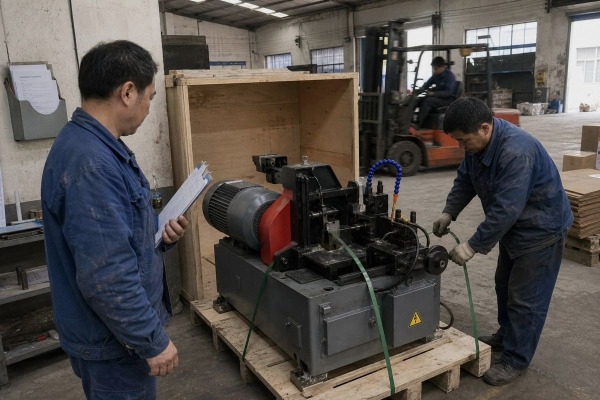
Buyers often ask me if CE certification alone will clear a [pipe cutting machine](https://yqunique.com/?p=5705) through US customs. On our Wenzhou production line, we answer this question almost weekly.
To import a pipe cutting machine to the US, request the EU Declaration of Conformity, technical construction file, test reports, risk assessment documentation, and user manual. However, CE marking alone is not recognized by US authorities—you also need NRTL certification or a field evaluation for legal workplace use.
That answer surprises many first-time importers. Let me break down exactly what CE documents matter, what US rules apply, and how to avoid costly delays.
A US procurement manager once told me his previous supplier sent only a one-page "CE certificate" with no supporting files. When his inspector asked questions, he had nothing to show. We now confirm two things upfront with every buyer: which CE directives apply to their specific pipe cutting machine, and which CE documents they need to collect from us before shipment.
Request the EU Declaration of Conformity, the technical construction file index, electrical and EMC test reports, the risk assessment documentation, wiring diagrams, the bill of materials, component certificates, the user manual, and photos of the nameplate and safety labels. A verbal "CE certified" claim is never enough.

The Declaration of Conformity (DoC) is your starting point. It names the directives the manufacturer claims to meet. For a pipe cutting machine, the core one is the Machinery Directive 1 2006/42/EC. Depending on the electrical design, the Low Voltage Directive 2 and the EMC Directive may also apply. If the DoC does not list these, ask why.
Here is the exact package I recommend requesting before you pay the final balance:
| Document | Why It Matters | Red Flag If Missing |
|---|---|---|
| EU Declaration of Conformity | Names directives and harmonized standards | Machine may never have been assessed |
| Technical construction file (or index) | Contains drawings, BOM, safety circuit details | Supplier cannot prove design conformity |
| Test reports (electrical, EMC) | Shows actual testing occurred | "CE" may be self-declared with no evidence |
| Risk assessment documentation | Shows hazards were identified and reduced | Guarding may be inadequate |
| User manual and wiring diagrams | Needed for installation and US inspection | Installer cannot verify compliance |
| Nameplate and label photos | Confirms voltage, ratings, and markings | Machine may not match paperwork |
The technical construction file usually holds product specifications, safety circuit logic, and component certificates for critical parts. Even though CE is not a US approval, this file helps your electrician or field inspector assess the machine against US expectations. In our export packs for American customers, we include the file index plus wiring diagrams so their installer sees the full electrical configuration before the crate arrives.
Also ask whether any design changes were made after testing. A machine modified after its CE assessment may no longer match its own documentation.
There is a trade-off we weigh on every US-bound build: design the machine to European norms only, or add US-specific features from the start. Our engineers learned early that a CE-only machine often needs guarding and wiring changes before an American plant inspector will accept it.
Compare the machine against OSHA 29 CFR 1910.212 for guarding, NFPA 79 for electrical construction, and the ANSI B11 series for machine safety design. Then arrange NRTL certification or an on-site field evaluation, since CE compliance does not satisfy OSHA safety standards on its own.

CE and US requirements come from different legal systems and different standards. A machine can fully comply with European norms and still fail a US inspection. The most common failure points are electrical, not mechanical.
The European electrical standard EN 60204-1 and the US NFPA 79 electrical standard conflict in several practical ways. Wire color codes differ. Emergency stop buttons must follow the red-on-yellow requirement under US rules. Grounding conductor markings differ too. These sound like small details, but a local inspector (AHJ) can red-tag the whole machine over them.
| Area | EU Approach (CE) | US Expectation |
|---|---|---|
| Electrical construction | EN 60204-1 | NFPA 79 electrical standard |
| Machine guarding | Machinery Directive essential requirements | OSHA 29 CFR 1910.212 + ANSI B11 series |
| Certification model | Manufacturer self-declaration allowed | Third-party NRTL certification with factory surveillance |
| Emergency stops | EN ISO 13850 | Red-on-yellow mushroom buttons per NFPA 79 |
| Legal responsibility | Manufacturer places CE mark | US employer bears the burden under OSHA's General Duty Clause |
Here is the point many importers miss. OSHA's General Duty Clause, Section 5(a)(1), places the legal burden on the US employer to keep the workplace free from recognized hazards. Foreign certifications do not transfer that liability away. If your CE-standard pipe cutting machine lacks point-of-operation guarding that meets OSHA 29 CFR 1910.212, physical modifications may be required before workers can operate it. When we build for US customers, we review guarding, interlocks, and e-stop logic against the ANSI B11 series before the machine leaves our floor.
A distributor in Ohio once asked me why his insurer questioned a machine that cleared customs without any issue. The answer highlights a gap in most importers' thinking: customs clearance and legal workplace use are two separate hurdles.
No, CE marking alone is not enough. US customs does not require CE, UL, or FCC marks to release industrial machinery, but OSHA safety standards effectively require NRTL certification such as UL or ETL for workplace use, and FCC authorization applies if the machine contains radio or digital electronics.

CE marking is a European Union regulatory requirement. It has no legal standing with US Customs and Border Protection 3 or with OSHA. So the CE mark neither helps nor hurts at the border. What matters at the border is your paperwork; what matters after the border is safety certification.
Watch out for the "component vs. assembly" misconception. A machine built with UL-listed motors, drives, and power supplies is not itself UL listed. UL listing requirements apply to the complete assembly, and local inspectors can red-tag an uncertified machine even when every internal part carries a mark. There is also an insurance angle: operating non-NRTL listed machinery can trigger non-compliance clauses in commercial property and liability policies, potentially leading to denied claims after a fire or injury. That risk alone justifies doing this properly.
Shipping day taught us our most expensive lesson years ago: a crate held at port for two weeks because the invoice description did not match the HS code. Since then, our export team pre-checks every document set against the buyer's broker requirements before the container is booked.
Prepare a complete commercial invoice, packing list, and bill of lading, classify the machine under the correct HS code in Chapter 84, work with a licensed customs broker, and pre-arrange NRTL field evaluation so the machine is ready for installation as soon as it clears.

Customs delays rarely come from missing safety marks. They come from sloppy paperwork, wrong classifications, and mismatched values. Here is a practical process that has worked for our shipments to the United States, Germany, and Japan alike.
| Step | Action | Who Handles It |
|---|---|---|
| 1 | Confirm the HS code under Chapter 84 with your broker | Importer + broker |
| 2 | Collect the full CE document pack (DoC, technical file, test reports) | Supplier |
| 3 | Verify invoice, packing list, and bill of lading match exactly | Both parties |
| 4 | Photograph the nameplate, ratings, and safety labels | Supplier |
| 5 | Book an NRTL field evaluation 4 before the machine ships | Importer |
| 6 | Confirm voltage, plug, and wiring match the US site | Supplier + installer |
For a one-off imported machine, a field evaluation (field labeling) by an NRTL is the high-value shortcut. A certified inspector approves your specific unit on-site in the US without requiring full factory certification. This route fits customized or non-standard machines especially well. We often supply the risk assessment documentation, wiring diagrams, and component certificates in advance so the field evaluator can prepare before the machine even arrives, which shortens the acceptance timeline.
One more practical tip: put the CE documentation and the US-facing documents in the same folder and share it with your broker, your installer, and your insurer at the same time. Consistent paperwork across all three parties is the cheapest delay prevention there is.
CE documents are useful evidence, not a US import passport. Collect the full CE file, add NRTL certification or a field evaluation, and prepare clean customs paperwork before shipping.
1. Official European Commission page for the Machinery Directive, the primary safety standard for equipment in the EU. ↩︎
2. Official EU guidance on the Low Voltage Directive, which covers electrical safety requirements for industrial machinery. ↩︎
3. The official website for the US agency responsible for regulating international trade and processing imported goods. ↩︎
4. OSHA’s official resource explaining the NRTL program and the field evaluation process for industrial equipment safety. ↩︎
