

Buyers often ask me why their fully automatic pipe cutting machine budget explodes after delivery. On our production line in Wenzhou, we see the reason daily: the quote is only the beginning.
The hidden costs of a fully automatic pipe cutting machine include installation and rigging, electrical and facility upgrades, assist gas expenses, software licensing fees, operator training programs, maintenance and spare parts, plus downtime losses that can reach thousands of dollars per hour.
The purchase price is visible. The rest is not. In this article, I break down every cost layer so you can budget the real number, not the sticker number.
A German distributor once asked me to justify our mid-to-high-end pricing. I sent him one formula instead of a discount, and he signed the order two weeks later.
Calculate total cost of ownership with this formula: purchase cost + installation cost + operating cost + maintenance cost + downtime losses + lifecycle cost. Sum all six categories over the machine's expected service life, then divide by total parts produced to reveal your true cost per cut.

That formula is the one I use with every serious buyer. Total investment = purchase cost + installation cost + operating cost 1 + maintenance cost + downtime loss + lifecycle cost. It looks simple. But most procurement teams only budget the first item. Then the surprises start.
Let me put real numbers behind each category. Entry-level automatic machines can range from $5,000 to $15,000. Mid-range systems run $15,000 to $40,000. High-end automated laser systems can exceed $100,000, and some full automation packages reach $250,000 or more. So the purchase cost alone varies wildly. The hidden layers scale with it.
| Cost Layer | Typical Range | When It Hits You |
|---|---|---|
| Purchase cost | $5,000–$250,000+ | At order |
| Installation and rigging | $5,000–$12,000+ | At delivery |
| Operating cost (energy, gas) | $5–$10/hour for a 3kW laser | Every shift |
| Maintenance and spare parts | $5,000–$10,000/year (laser) | Ongoing |
| Downtime losses | Thousands per hour | Unpredictable |
| Lifecycle cost (upgrades, disposal) | Varies | Years 3–10 |
Here is the objection I hear most: "Automation pays for itself through labor savings, so why worry?" That view is half right. Automation does cut direct labor. But it shifts costs into infrastructure, skilled technicians, and specialized consumables. The machine only pays back if your volume, demand stability, and support capability match its automation level. When we design custom systems for clients, we always run this six-layer model first. A cheaper machine with poor uptime often costs more per part than a premium one that runs continuously.
Last year, a Mexican client emailed me in a panic. His previous supplier had vanished, and a worn chuck jaw had stopped his entire cutting line for eleven days.
After warranty, expect annual maintenance costs of roughly $5,000–$10,000 for laser-based pipe cutting systems. Budget for consumable replacement parts like nozzles, lenses, chuck jaws, and blades, plus service call fees, calibration visits, and shipping time for replacement components.

That client's story shaped how we handle after-sales at our factory. We now ship a recommended spare parts kit with every machine, because waiting weeks for one small part is the most expensive mistake a buyer can make.
Maintenance costs fall into two buckets: predictable and unpredictable. The predictable side is your preventive maintenance schedule. This covers lubrication, alignment checks, lens cleaning on laser systems, and blade or wheel replacement on mechanical cutters. The unpredictable side is failures, and those hurt more because they combine repair cost with lost production.
| Component | Typical Replacement Trigger | Cost Impact |
|---|---|---|
| Cutting nozzles / blades | Every few weeks to months | Low per unit, high in volume |
| Protective lenses (laser) | Contamination or damage | Moderate, frequent |
| Chuck jaws and clamps | Wear from gripping cycles | Moderate |
| Drive belts and pulleys | Annual inspection | Low |
| Guide rails and bearings | Multi-year, load dependent | High |
| Coolant pumps and hoses | Fluid degradation | Low to moderate |
My advice from years of exporting to the US, Japan, and Germany: negotiate the post-warranty parts price list before you sign the purchase contract. A supplier who hesitates to share it is telling you something.
One trade-off we weigh on every export order is crate size versus rigging cost. A larger, pre-assembled crate reduces installation labor abroad but raises freight. There is no free option.
Yes. Budget $3,000–$10,000 for freight, $2,000+ for rigging and placement, possible electrical upgrades for 3kW–6kW power sources, $5,000–$10,000 in software licensing fees, and one to four weeks of operator training and onboarding before the machine reaches full productivity.

These pre-production costs cluster into four groups, and each one can surprise a first-time buyer.
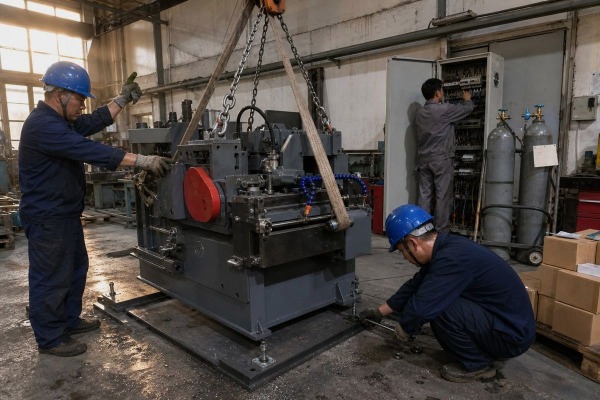
Large tube processing machines are heavy. A standard 6-meter tube laser may need a 40-foot high cube container, or even two. Freight typically runs $3,000–$10,000, and rigging adds $2,000 or more if you need cranes or heavy forklifts. Installation and rigging also touch your building: floor loading, door widths, and safety clearances all matter. For a small shop, this single line item can be a genuine budget shock. Some buyers also need contractors, permits, or scheduled downtime just to move the machine into position.
There is a difference between machine energy use and facility readiness. A 3kW–6kW laser source may require electrical service upgrades. You may also need better compressed air 2, ventilation, and dedicated floor space. Energy consumption rates then continue as an hourly cost: a 3kW fiber tube laser runs roughly $5–$10 per hour excluding labor. Assist gas expenses stack on top. Nitrogen cutting costs meaningfully more than oxygen, and some shops invest $15,000+ in a nitrogen generator 3 to escape bottled gas logistics, storage, and supply interruptions.
Software licensing fees can add $5,000–$10,000 to your effective setup cost. Even bundled software may require paid nesting tools, CAM workflows, or ERP integration. Network integration and data security for connected machines add further scope. Poorly integrated software quietly erases the productivity gains you paid for.
Automation does not eliminate labor; it changes the labor mix. You need fewer floor operators but more skilled programmers and maintenance technicians. Structured operator training programs shorten the ramp-up, but you still depend heavily on one or two trained people. If that person leaves, your expensive machine slows down. When we commission smart PLC-controlled systems for clients, we insist on training at least two operators, never one. That redundancy is cheap insurance.
A lesson I learned early in this business: buyers forgive a higher price faster than they forgive a stopped production line. Our whole QC process was rebuilt around that truth.
Downtime on a fully automatic pipe cutting machine can cost thousands of dollars per hour in lost production, while quality inconsistencies raise material scrap rates, rework labor, and secondary finishing costs. Because automation concentrates output in one machine, a single failure can halt your entire line.

Downtime is the most punishing hidden cost because it multiplies. You lose machine output, operator time, delivery schedule, and sometimes customer trust, all at once. With manual or semi-automatic processes, downtime is distributed: one station fails, the others keep working. A fully automatic system concentrates that risk. One servo fault, one control error, one worn feeder, and the whole stream stops.
| Factor | Fully Automatic | Semi-Automatic / Manual |
|---|---|---|
| Failure impact | Entire line stops | Single station affected |
| Cost per hour of downtime | Thousands of dollars | Lower, absorbed by other stations |
| Recovery dependency | Specialist technician, specific parts | General mechanic, common parts |
| Mitigation | Spare parts inventory, service contracts | Operator flexibility |
Quality inconsistency is the quieter cost. When automation is matched well to the work, it improves consistency and reduces scrap. But an over-specified or under-supported machine does the opposite. Choosing full automation for low-volume, highly variable work often produces underutilization, setup errors, and off-spec parts. Every bad cut costs three times: wasted material, rework labor, and secondary finishing costs 4 like deburring or re-chamfering that a clean cut would have avoided. Raw material quality feeds into this too; bent or out-of-tolerance tube stock forces the machine to compensate, and straightness premiums on incoming material are part of your real operating cost.
The practical defense is threefold. Keep a stocked spare parts inventory. Sign a service agreement with defined response times. And be honest about whether you truly need laser precision, bevel cutting, or robotic loading, or whether a simpler machine delivers better ROI for your volume.
Hidden costs do not make a fully automatic pipe cutting machine a bad investment. They make it a systems decision. Budget all six cost layers upfront, and automation pays back reliably.
1. ISO standard for service life planning, providing a framework for calculating long-term operating and maintenance costs. ↩︎
2. Department of Energy resources regarding the optimization and energy efficiency of industrial compressed air systems. ↩︎
3. Technical overview of nitrogen generation technology, a key component in reducing gas logistics costs for laser cutting. ↩︎
4. This NIST report specifically links finishing methods to manufacturing cost savings, providing an authoritative .gov source. ↩︎
