

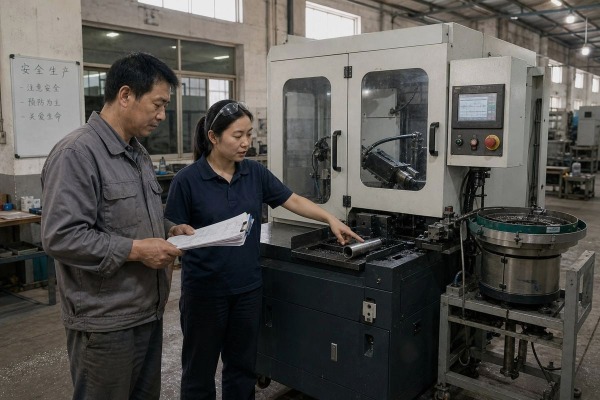
Choosing a chamfering machine supplier by catalog specs alone is a trap I see buyers fall into constantly. Your parts will change. Your tolerances will tighten. If your supplier cannot iterate quickly, every design change becomes a months-long crisis. On our production line in Wenzhou, we learned this the hard way before we rebuilt our whole engineering workflow around fast design-test-revise cycles.
To assess a chamfering machine supplier’s rapid iteration ability, evaluate four things: their R&D team’s depth, their engineers’ hands-on machine expertise, their proven customization workflow from drawings to witnessed testing, and the breadth of their overall SKU range showing real development history.
Those four dimensions sound simple. But most buyers do not know what evidence to ask for. Let me walk you through each one, section by section.
A procurement manager from Mexico once asked me for our full New Product Introduction 1 (NPI) timeline before he would even discuss pricing. That request changed how I present our capabilities.
Look for a documented development timeline with defined stages: drawing review within days, a technical proposal or 3D concept within one to two weeks, prototype testing before shipment, and a stated number of revision rounds. Vague promises without stage gates signal weak iteration capability.

A real product development timeline is not one number. It is a chain of stage gates, and each gate tells you something about the supplier’s discipline. When we handle a custom chamfering project at our factory, we break the loop into clear phases. I recommend you demand the same breakdown from any supplier you evaluate.
Here is the structure I would audit, based on how we run projects internally:
| Stage | What to Expect | Warning Sign |
|---|---|---|
| Drawing review | Engineers respond with technical questions in 2–3 days | Only a salesperson replies |
| Technical proposal / 3D concept | Delivered within a defined number of days, with tolerances stated | “We’ll see after you pay” |
| Design for Manufacturing (DFM) feedback | Supplier flags part features that affect tooling or cycle time | No feedback on your drawings at all |
| Prototype and sample run | Testing on your actual parts, with video or measurement data | Only generic demo parts shown |
| Revision rounds | A stated number included before sign-off | Unlimited “flexibility” with no process |
| Pre-shipment acceptance | Documented run-off criteria | Shipment footage only, no in-process records |
Notice the difference between fast quoting and fast engineering iteration. A supplier can send you a price in an hour and still take four months to engineer a real solution. Speed at the front end means nothing if the middle stages are undefined. In our experience exporting to markets like the US, Canada, and South Korea, buyers who audit these stages upfront cut their real Time to Market (TTM) significantly, because problems surface at the proposal stage instead of at commissioning.
Also ask about Engineering Change Order (ECO) handling. If your part revision arrives mid-project, how does the supplier document it, price it, and re-validate it? A supplier with a real ECO process 2 can absorb changes. One without it improvises, and improvisation on a chamfering machine usually means chamfer angle drift and burr complaints later.
Our team in Wenzhou is deliberately small — ten people covering R&D, engineering design 3, manufacturing, sales, and after-sales. That structure taught me something important: headcount matters far less than what each engineer can actually do at the machine.
Evaluate the R&D team by testing whether engineers can read your drawings, discuss tolerances and trade-offs directly, and demonstrate machine-level expertise. Check the ratio of design engineers to sales staff, and verify the team behind the catalog is the team doing the engineering.

The single fastest test I know is this: send your part drawing and ask a technical question that a salesperson cannot answer. For example, ask how wall thickness variation on your tube will affect chamfer consistency at your target cycle time. Watch who replies and how long it takes. If a design engineer answers within a day with specifics, you have found engineering depth. If the reply is a generic brochure, you have found a trading company or a catalog-only factory.
From my side of the table, these are the signals that separate a capable R&D team from a re-badged one:
Ask for the R&D reinvestment picture too. A supplier that treats R&D as a cost center will always deprioritize your iteration requests behind standard production. A supplier that treats it as their differentiator — as we do, since customization is the core of our business model — will staff and schedule around it.
One more point from my own hiring experience: an engineer who has personally commissioned machines at customer sites iterates faster than one who has only worked at a desk. Field exposure builds the judgment that shortens revision cycles. Ask how many of the supplier’s engineers have done overseas or on-site commissioning.
The trade-off I weigh most often is this: run a customer’s sample test properly, which takes days, or ship faster and hope. We always choose the sample test, because every skipped test I have ever heard about resurfaced as a commissioning nightmare.
Ask five things: how many days from drawings to a testable prototype, whether they test on your actual material, what measurement data they share, how many revision rounds are included, and whether you can witness the run-off before shipment, in person or by live video.

Prototype testing is where rapid iteration becomes visible. Everything else is a promise; the sample run is proof. When customers send us their cable lugs, terminals, or metal parts, we run them on the actual machine configuration before shipment and send video plus measurement results. I would never accept less from a supplier myself, and neither should you.
Use this checklist in your first technical call. Score the answers, do not just collect them:
| Question | Strong Answer | Weak Answer |
|---|---|---|
| What data do you need to start? | Drawings, material grade, hardness, diameter range, wall thickness, cycle time, annual volume | “Just send anything” |
| Days from drawings to prototype? | A specific committed range | “It depends” with no range |
| Do you test on our real parts? | Yes, ship us samples; we test and record | “Our demo parts are similar” |
| What results do you share? | Video, dimensional measurements, cycle-time data | Final shipment footage only |
| How many revisions are included? | A defined number, with ECO pricing beyond that | “As many as needed” (unpriced and unscheduled) |
| Can we witness the run-off? | On-site or live video acceptance test | “Trust us” |
Here is a practical trick: request a small but realistic change, then measure the full loop — drawing review, proposal, sample, revision, acceptance. That single test exposes the supplier’s true manufacturing agility metrics better than any brochure. Suppliers with in-house rapid prototyping resources, modular machine design 4, and quick-change tooling interfaces can turn this loop in days. Suppliers who outsource tooling or lack test benches will stall exactly here.
Also probe test discipline. Does the supplier have calibrated measuring equipment? Do they document each revision so results are traceable? A supplier that only inspects the finished machine, rather than testing in-process, cannot catch iteration-related defects early. On our floor, sample testing and tooling verification happen before final assembly, precisely because fixing a fixture at that stage costs hours instead of weeks.
A buyer from Slovakia once asked me a question I now consider brilliant: “Show me the same machine type, built three different ways for three different customers.” That request cuts straight to the truth.
Verify the track record by reviewing the supplier’s overall SKU breadth and machine variants, requesting sample technical proposals and revision records from past custom projects, checking reference customers in your region, and confirming documented ECO handling and post-install support commitments.

Customization capability is not a claim; it is a paper trail. A supplier who has genuinely adapted machines to dozens of different parts will have the evidence sitting in their project files: technical proposals, tooling drawings, revision notes, test records, and commissioning documentation. Ask to see redacted versions. When we work on OEM/ODM projects, our proposals, tooling designs, and acceptance records are exactly the artifacts I show new buyers, because they prove process discipline better than any sales pitch.
This is a point I weigh heavily from my own experience: the overall SKU count tells a story. A supplier with one fixed chamfering model has iterated once. A supplier with many variants — different feeding systems, chamfer angle ranges, control configurations, and part-size envelopes — has run the full customization loop many times. Each SKU represents a completed design-test-revise cycle. Breadth is fossilized iteration history.
Look also at the platform philosophy behind the SKUs. Modular machine design with standardized tooling interfaces means the supplier can update hardware without a total redesign. Recipe-based control operation, adjustable chamfer angles, automatic feed, and PLC integration 5 signal a configurable platform rather than a fixed-purpose machine. These features support Industry 4.0 integration and directly affect your production scalability when your part mix grows.
| Evidence | What It Proves |
|---|---|
| Sample technical proposal on your drawings | Engineering depth and DFM thinking |
| Revision records from a past project | Systematic ECO handling, not improvisation |
| Machine variant list (SKU range) | Repeated, completed iteration cycles |
| In-process testing photos or video | Quality control before final assembly |
| Reference customers in your region | Delivery reliability and commissioning success |
| Installation, training, and troubleshooting docs | Post-sale support for future revisions |
Finally, check the after-sales commitment in writing. Rapid iteration does not stop at shipment. When your parts change next year, you will need remote debugging, tooling updates, and fast engineering responses. Our export experience across India, Vietnam, Malaysia, and North America taught me that suppliers who commit to defined response times keep customers through multiple machine generations; suppliers who go quiet after payment force you to restart this entire evaluation from zero.
Assess a chamfering machine supplier on R&D depth, engineer expertise, tested customization workflow, and SKU breadth. Audit the full iteration loop with your own drawings — never trust catalog claims alone.
