

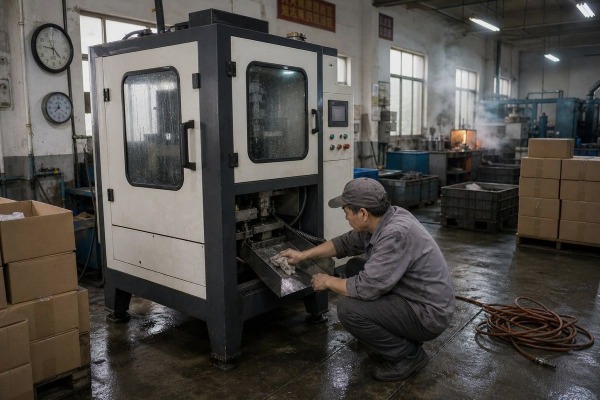
A fully automatic chamfering machine is a precision tool, and I have watched buyers underestimate how heat and moisture quietly destroy one sealed IP-rated cabinets 1. On our Wenzhou production line, we treat environmental factors as seriously as spindle accuracy—because a rusted rail or drifting sensor can shut down an entire shift.
Yes, a fully automatic chamfering machine can work in moderately high-temperature or humid environments, but only within the manufacturer’s rated envelope. Keep the area dry and ventilated, apply anti-rust oil regularly, ensure proper heat dissipation, and avoid condensation or corrosive air for reliable long-term operation.
The real question is not whether the machine is automatic electrical insulation 2. The real question is whether its electronics, mechanics, and pneumatics are rated for your plant’s specific heat and moisture. Let me break this down step by step.
Before we ship any chamfering machine from our factory, we ask the buyer one question first: what does your shop floor actually feel like in July? The answer changes everything about the build.
Check the operating temperature range (typically 10°C–30°C), relative humidity limits (often 10%–60%, non-condensing), IP rating of enclosures, power stability requirements, and compressed air quality. Also confirm the machine excludes corrosive air, dust, and condensation from its rated conditions.

Most standard automatic chamfering machines are designed for controlled indoor factory conditions, not for foundry heat or coastal humidity. One typical product spec sheet lists an operating temperature range 3 of 10°C–30°C and relative humidity of 10%–60%, with explicit notes: no condensing, and no corrosive air or liquid. That is a much narrower envelope than many buyers assume.
These machines also depend on stable industrial utilities. A common configuration needs 380V power and compressed air at 0.6 MPa or higher. That alone tells you the machine expects a proper industrial installation, not an exposed or semi-outdoor site.
Here is the checklist I walk through with every procurement manager before quoting:
| Specification | Typical Standard Rating | What to Ask the Supplier |
|---|---|---|
| Operating temperature | 10°C–30°C | Can it be extended with cooling upgrades? |
| Relative humidity | 10%–60%, non-condensing | Is condensation explicitly excluded? |
| Ingress Protection (IP) | Basic cabinet sealing | What IP rating protects the electronics? |
| Air atmosphere | No corrosive air or liquid | Any salt, acid vapor, or chemical mist on site? |
| Power supply | 380V, stable voltage | Do you have voltage stabilization? |
| Compressed air | ≥0.6 MPa, dried and filtered | Is your air line fitted with a dryer? |
“High temperature” could mean a warm workshop at 35°C, a heat-treatment area at 50°C, or a near-furnace zone. Only the first is plausibly workable for a standard unit. Likewise, “humid” could mean moderate 70% humidity, condensation-prone air, or corrosive tropical marine conditions. Standard machines may tolerate moderate humidity with protection, but condensing moisture is a hard stop in most spec sheets. Define your environment precisely before you buy—vague answers lead to warranty disputes later.
A few years back, one of our export customers in Southeast Asia reported chamfer angles drifting out of tolerance every afternoon. The cause was not the machine—it was a 12°C daily temperature swing on an unconditioned shop floor.
Heat causes thermal expansion, electronics drift, lubricant thinning, and motor overheating, which reduce dimensional accuracy. Humidity causes rust on rails and spindles, degraded electrical insulation, contaminated lubricants, and sensor errors. Together they shorten equipment longevity and raise failure rates significantly.

Automatic chamfering machines can support production rates of 600 to 5,000 parts per hour. That throughput depends on repeatable, CNC-controlled cutting. Any environmental stress that pushes the machine out of tolerance costs you real money in scrap and downtime—and the failure modes compound over time.
Heat attacks a chamfering machine on several fronts at once. First, thermal expansion 4 changes the geometry of the frame, ball screws, and spindle. Even a small expansion shifts the chamfer angle and depth. Second, high ambient temperature reduces the cooling headroom of servo motors and drives, so they run hotter and trip protection circuits or degrade faster. Third, lubricants thin out at elevated temperatures, which increases friction and wear on linear guide rails. Fourth, cutting tools lose hardness and wear resistance faster when both ambient and cutting temperatures rise, so insert life drops.
Moisture is quieter but just as destructive. Corrosion resistance becomes the deciding factor for machine reliability in humid plants. Here is how the damage typically progresses:
| Component | Humidity Damage | Typical Timeline |
|---|---|---|
| Guide rails and ball screws | Surface rust, pitting, binding | Weeks to months without protection |
| Electrical cabinet and PLC | Insulation breakdown, shorts, corrosion on contacts | Gradual, then sudden failure |
| Sensors and encoders | False readings, signal drift | Intermittent errors early on |
| Pneumatic system | Water in air lines, sticky valves | Depends on air dryer quality |
| Lubricants | Emulsification, contamination | Accelerates all mechanical wear |
Condensation is the worst case. When humid air meets a cool machine surface—common after a night shutdown—water forms directly on precision parts and inside cabinets. That is exactly why spec sheets say “non-condensing.” In my experience, condensation cycles do more damage in one rainy season than years of normal running.
Our after-sales team keeps a simple rule that we share with every customer in a humid export market: keep the environment as dry as possible, coat exposed metal with anti-rust oil on a fixed schedule, and never block the heat dissipation paths.
Keep the workspace dry with dehumidification and ventilation, apply anti-rust oil to exposed metal surfaces on a regular schedule, ensure unobstructed cooling airflow, drain compressed air lines daily, inspect electrical grounding, and shorten lubrication intervals in hot or humid conditions.

Maintenance requirements in a harsh climate are not just more frequent versions of normal maintenance. They shift priority toward moisture control and thermal management. Based on what we have learned supporting machines in Vietnam, Malaysia, India, and coastal Mexico, here is the routine I recommend.
Sometimes the cheapest fix is not on the machine at all. A room dehumidifier, an insulated wall, or simply relocating the machine away from a furnace or open loading door can bring conditions back inside the rated operating temperature range. I have seen a single industrial dehumidifier extend a machine’s trouble-free life by years. Keeping the machine powered on standby in humid climates also helps, because internal warmth prevents condensation from forming on cold metal overnight.
Customization is where most of our engineering conversations start. When a buyer sends us drawings along with a note that the machine will sit near a heat-treatment line or in a coastal plant, we redesign specific subsystems rather than sell the standard unit.
Yes. Manufacturers can upgrade machines with sealed IP-rated cabinets, stainless steel or coated components, high-temperature lubricants, cabinet air conditioners, dehumidifiers, tropicalized electronics, corrosion-resistant fasteners, and environmental sensors that adjust operating parameters automatically. Customization extends the machine’s usable environmental envelope.

There is a genuine debate here that buyers should understand. One view says these machines already run fine in humid or hot shops, since suppliers sell them worldwide for robust production settings. The opposing view points to the strict spec-sheet limits and says harsh environments demand special design. Both are true—and the resolution is simple. Standard machines handle ordinary factory environments. Extreme environments require engineering modifications or a different machine class. Industrial durability is a design choice, not a default feature.
| Upgrade | Protects Against | Best For |
|---|---|---|
| IP-rated sealed electrical cabinet | Moisture, dust, spray | Humid, dusty, or washdown-adjacent areas |
| Cabinet air conditioner or heat exchanger | Ambient heat, electronics drift | Shops above 35°C or near furnaces |
| Cabinet dehumidifier / heater | Internal condensation | Coastal and tropical plants |
| Stainless steel or coated components | Rust and pitting | Salt air, chemical vapor exposure |
| Tropicalized PCB coatings | Insulation breakdown | Sustained high humidity |
| High-temperature synthetic lubricants | Lubricant thinning and breakdown | Hot ambient conditions |
| Temperature and humidity sensors with PLC logic | Undetected environmental stress | Any harsh or variable site |
Our process starts with an environmental survey: peak temperature, humidity profile, airborne contaminants, and utility quality. Then our engineers select sealing solutions and materials to match. On one project for a customer in a hot climate, we added a cabinet cooler, switched to sealed connectors, and specified corrosion-resistant hardware on all exposed fasteners. Advanced builds can go further—sensors that monitor real-time temperature and humidity let the control system reduce cutting speed or increase cooling when conditions spike, protecting both accuracy and component life. The cost premium is real, but it is far smaller than the cost of repeated downtime on a high-throughput line.
Ignoring environmental limits risks rust, drift, and costly downtime. Match the fully automatic chamfering machine to your site—verify specs, maintain diligently, and customize where needed. Contact us to discuss your environment.
