

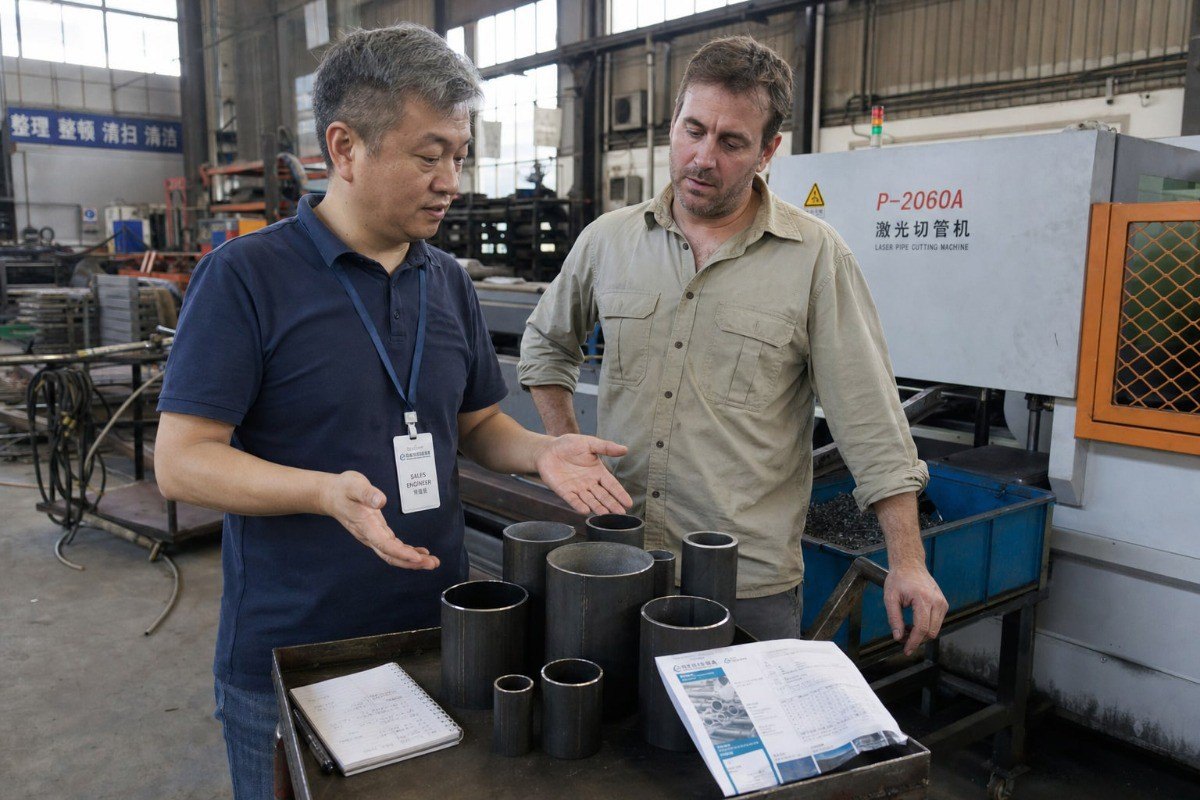
Identifying customer needs for fully automatic pipe cutting machines is where most deals go wrong total cost of ownership 1. On our Wenzhou production line, I have watched buyers order the wrong spec, lose months, and pay twice.
To identify customer needs for fully automatic pipe cutting machines, ask structured questions about materials, pipe size range, cut quality, production throughput, automation level, budget, and workflow integration. Then translate those answers into measurable machine specifications before recommending any equipment.
That sounds simple. But most sellers skip the discovery stage and jump straight to a catalog. Let me walk you through the exact process we use with our overseas clients.
A procurement manager from the US once messaged me on WhatsApp asking for “your best pipe cutter.” Our team replied with twelve questions instead of a price. He later told me that questionnaire saved him from buying a machine that could not handle his stainless tube.
Ask buyers what materials they cut, the minimum and maximum pipe diameter, material wall thickness, required cut types, daily output targets, current labor costs, and downstream processes. These questions reveal true requirements that a simple machine request never exposes.

The core insight I have learned from years of exporting metal processing machines is this: buyers are not asking for a machine. They are asking for a solution to a production problem. Your questions must dig for that problem.
I group my discovery questions into six areas. Each one maps directly to a machine specification later.
| Question Category | Example Questions | What It Tells You |
|---|---|---|
| Material | Carbon steel, stainless, aluminum, or copper? | Blade type, cutting power, coolant needs |
| Dimensions | Min/max outer diameter? Material wall thickness? Tube length? | Chuck range, bed length, feeding solution |
| Cut Quality | Square cuts, miters, or bevels for weld preparation 2? | Whether a pipe beveling machine function is needed |
| Volume | Pieces per shift? Steady or seasonal demand? | Cycle time and automation level |
| Workflow | Who loads and unloads today? Any deburring after cutting? | Automatic loading system requirements |
| Service | In-house maintenance staff? Response time expectations? | Support plan and training scope |
Start with materials and dimensions. These are facts the buyer knows well, so they answer easily. Then move to volume and workflow. These questions are harder, and the buyer often has to check with the floor team. Save budget questions for last, after trust is built.
One more tip from experience. Always ask about nonstandard profiles. A customer may cut round pipe 95% of the time, but that 5% of square tube or oval profile can disqualify half the machines on the market. Never assume the mix is uniform.
There is a trade-off we weigh on every project at our factory: oversizing a machine wastes the customer’s money, while undersizing it kills their production schedule. Getting capacity right is a math exercise, not a guess.
Determine cutting capacity by converting the customer’s output target into a required cycle time, then matching pipe diameter range, material wall thickness, and cut complexity to machine specifications. Always size for the hardest material and thickest wall in the real part mix.

Capacity planning starts with one number: pieces per shift. From there, everything else follows. Here is the simple process our engineers use when we design non-standard solutions for clients.
A servo-driven feed system 4 matters here. It controls length accuracy and repeatability across long production runs. If the customer needs tight tolerances for weld preparation, a servo-driven feed paired with a solid CNC control system 5 is non-negotiable. If they only need rough cross-cuts, a simpler feed may work.
| Customer Requirement | Key Specification to Check |
|---|---|
| High volume, one diameter | Fast cycle time, dedicated tooling |
| Mixed diameters | Wide chuck range, quick changeover |
| Weld-ready ends | Integrated beveling, burr-free cutting capability |
| Long raw stock | Automatic loading system with bundle feeding |
| Tight length tolerance | Servo-driven feed with closed-loop control |
One story I tell often: a client in Germany specified capacity from his sales forecast, not his floor reality. His actual bottleneck was manual unloading. We added an automated outfeed, and his throughput jumped without touching cutting speed. Capacity is a system question, not just a blade question.
A lesson that cost us a deal early on: we quoted a fully loaded system to a small Indian workshop with two operators and no maintenance technician. The price scared them off, and honestly, the machine would have been wrong for them anyway.
Assess budget by calculating total cost of ownership, not purchase price alone. Include consumables, energy, maintenance, labor savings, and scrap rates. Then check technical constraints: operator skill, maintenance capability, power supply, floor space, and software readiness before recommending full automation.
Budget conversations fail when both sides talk about different numbers. The buyer thinks about the invoice. The seller should think about the cost per cut piece over five years. Your job is to move the conversation to the second number.
Here is how I frame it for procurement managers. Customer needs are often economic needs in disguise. A company says it wants “automation,” but the real need may be lower unit cost, faster payback, or fewer rejected parts.
| Cost Element | Manual Cutting | Fully Automatic Machine |
|---|---|---|
| Upfront investment | Low | High |
| Labor per shift | 2-3 operators | 0.5-1 operator |
| Consistency and rework | Variable, higher scrap | Stable, material waste reduction |
| Consumables | Moderate | Predictable, trackable |
| Downtime risk | Spread across stations | Concentrated, needs support plan |
Budget is only half the assessment. I always check these constraints before proposing anything:
And here is the honest part. Fully automatic is not always the right answer. When volumes are low or cuts are simple, a semi-automatic machine with strong support often delivers better value. I would rather sell the right machine once than the wrong machine twice.
During a video call with a Mexican integrator last year, I asked him to walk his phone camera through the shop floor. Ten minutes of footage told me more than three weeks of emails. Workflow evaluation is about seeing, not just asking.
Evaluate workflow by mapping the full path of a pipe from raw stock to finished part: storage, loading, cutting, deburring, marking, and sorting. Identify manual touchpoints and bottlenecks, then recommend a solution that fits the entire process, not just the cutting step.
It is not enough to understand what the customer’s product processing range is. You must also understand how they currently produce and what capacity they truly need. That principle guides every workflow audit we run.
I follow a simple sequence. Each step exposes a hidden requirement.
From our project experience, full automation delivers the best return when several conditions align: high steady volume, standardized parts, operator shortage, and downstream automation already in place. Growing buyers also ask about scalability, so we design systems that accept added modules like marking or secondary drilling later. When these signals are missing, I recommend a staged approach. Automate loading first, prove the gains, then expand. That builds trust, and it protects the buyer from over-investing before their workflow is ready.
Guessing customer needs leads to wrong machines, lost time, and costly returns. Structured discovery — materials, capacity, budget, and workflow — turns vague automation interest into precise, low-risk pipe cutting machine specifications.
